
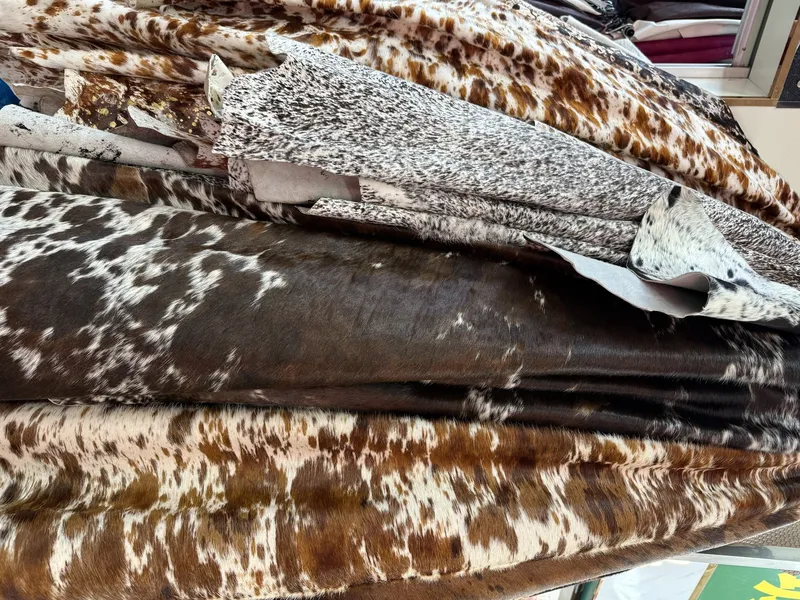
Do cows have hair or fur? Cows have hair, not fur! Cow Hair refers to leather that retains the original hair of the cow. It is usually sourced from adult cows and has longer and coarser hair compared to “calf hair” from young calves. Its style leans towards the western, casual or individualistic fashion.
In the fields of bag and clothing manufacturing, cow hair is highly favored. It retains the tough structure of leather while possessing unique natural textures and tactile qualities. It is often used to create vintage, wild or highly individualistic fashion items, such as the popular denim-patterned tote bags in recent years. Additionally, it is durable and easy to shape, combining beauty and practicality.
This post will explore these questions: What we would call cow fur? Is cow hair good for making bags?
What Would You Call Cow Fur?
“Cow fur” is usually called cowhair or simply cow hair.
In English, the concept of “cow fur” has different names in different contexts. In biology and everyday language, the skin of a cow is commonly referred to as “hide”. This word is also often used to generally describe the entire raw skin of any large animal, regardless of whether it has hair or not. If interpreted literally as “the fur of a cow”, using “cow hair” or more straightforwardly “cow skin with fur/hair” would be more accurate to ensure that others clearly understand that you are referring to the hair-covered skin.
Confusion in the Chinese context: In Chinese, the term “cowhair suede” may cause confusion. It does not refer to the wool of a cow, but rather a surface treatment process for leather. Cowhair suede is a type of suede leather made by sanding the cowhide. This leather is usually made from two layers of cowhide and has a soft touch and a tough texture.
Processed Products and Industry Terminology
When discussing processed products, the terminology becomes more specific:
- Cowhide: This is the most commonly used term, which can refer to raw cowhide or the processed material of cowhide used for making products such as bags, jackets, carpets, and accessories. Example: “The handbag is made from genuine cowhide.”
- Calfskin (small cattle hide): Specifically refers to the leather obtained from calves that are no more than 6 months old. It has an exceptionally soft and smooth texture. Example: “Calf hair leopard-print bag.”
- Bovine hair or bovine fur: This is the correct term, but it is less commonly used outside of scientific or agricultural fields. This term is also frequently used in the fashion industry, referring to leather materials that retain the original hair of the cow. It is used to make skirts, jackets, handbags, etc.
- Raw cowhide fur: This refers to unprocessed cowhide that has been simply stretched and dried, preserving the original appearance of the animal’s fur. It is often used to make special styles of accessories, such as the fur pouch on the Scottish skirt (sporran) or the Jewish prayer shawl case (tallit bag).
- Cow Fur: This is a concise and universal term used to refer to the hair on a cow, often used in daily or educational contexts.
- Cow Hair: Another simple descriptive term, usually used to emphasize individual hairs rather than the entire skin-hair layer.
- Hair-on hide or Cowhide with hair / Hair-on cowhide: This specifically emphasizes that the hair/fur remains on the leather. This is the most accurate and commonly used term in fashion and leather industries when referring to the skin of a cow that still has its natural hair.
Summary of Industry Terminology
| Chinese Name | English Name | Explanation & Characteristics | Common Uses |
| 带毛牛皮 | Hair on Hide / Cow Fur Leather | Leather that retains the animal’s original hair. Has a unique look, but the hair may shed naturally over time. | Western wear, rustic boots (e.g., Birkenstock), furniture upholstery. |
| 毛皮 | Fur | Refers to animal skins with dense, warm hair, usually from animals raised specifically for fur. | Fashion coats, stoles, hats, fur accessories. |
| 牛皮 | Cow Leather | Leather that has been de haired. The most common leather material, known for its strength and durability. | Bags, shoes, belts, furniture. |
| 仿毛皮 | Faux Fur | Completely synthetic (man made) material designed to mimic the look and feel of real fur. | Clothing, accessories – a popular alternative to animal fur. |
| 牛毛皮 | Cow fur/skin | A general term for leather that retains the animal’s original hair – essentially the same as Hair on Hide. In Chinese, it often specifically refers to this type of hairy leather. | Rugged shoes, bags, and unique furniture. |
Why Is “Cow Fur” Rarely Used?
Compared to “cow fur”, “cow hide” or “cow hair” are more commonly used in English to refer to cow skin. This is a conventional practice that has emerged over time: in people’s minds, the word “fur” is usually associated with animals with long and soft fur, such as foxes or minks. In contrast, the hair of a cow is shorter and has a coarser texture, so it is rarely classified as “fur” in language usage.
Do Cows Have Hair or Fur?
From a strict biological and common usage perspective, the animals like cows have hair instead of fur.
Scientific Distinction
| Feature | Hair | Fur |
| Structure | Usually a single layer, relatively coarse and stiff, longer growth cycle. | Typically two layers: dense, soft undercoat + longer guard hairs; overall thicker and fluffier. |
| Function | Primarily protection and sensory (e.g., whiskers); less effective for insulation. | Mainly insulation; the undercoat traps air to keep the animal warm. |
| Growth pattern | Grows continuously or sheds periodically; can become very long (e.g., human hair, horse mane). | Usually has a fixed length and is shed seasonally. |
Hair vs. Fur – A Multi‑Dimensional Comparison
| Dimension | Hair | Fur |
| Anatomical structure | Usually single layer; hair shaft is thicker, straighter, with a low proportion of medulla (core). | Typically two layers: a dense, soft underfur + longer guard hairs. |
| Density & thickness | Low density – fewer follicles per cm²; relatively sparse. | Extremely high density (e.g., sea otters can have tens of thousands of hairs per cm²); very thick. |
| Growth cycle | Long anagen (growth) phase, short telogen (resting) phase; can grow continuously to great length (e.g., human hair, horse mane). | Short anagen, long telogen; fixed seasonal shedding (spring and autumn). |
| Primary function | Sensation (whiskers), sun protection, insect deterrence, some insulation – but low thermal efficiency. | Core function is insulation; underfur traps still air to protect against cold. |
| Tactile feel | Smooth, relatively stiff, shiny; feels “silky”. | Soft, fluffy, elastic; feels “warm and velvety”. |
| Typical animals | Humans, horses, cows, pigs, goats, etc. | Arctic foxes, otters, rabbits, cats, polar bears, and other mammals that need high insulation. |
| Processing & uses | Often spun into yarn (wool, cashmere, mohair); when left on hide, called “hair on leather”. | Whole pelt is used for fur garments – coats, stoles, trims – luxurious and warm. |
| Commercial name | Finished product: “woolens” or “hair fabrics”; raw material: “hair”. | Finished product: “fur” or “furs”; raw material: “fur”. |
| Ethical controversy | Wool, cashmere, etc. are usually sheared (non lethal), less controversial. | Most fur requires killing the animal, highly controversial (“fur free” movement). |
| Cultural symbolism | Often associated with “civilisation”, “domestication” (e.g., humans trimming hair). | Often associated with “wildness”, “primitive”, “luxury”. |
Why Are There These Differences?
- Evolutionary adaptation: Mammals living in cold regions (such as Arctic foxes and otters) need extreme insulation capabilities, so they evolved double-layered dense fur; while humans and horses, etc., regulate their body temperature through other means (sweat glands, movement), a single-layered coarse hair is sufficient to meet the requirements.
- Gene regulation: The periodic activities of hair follicles are controlled by different genes. The hair follicles of fur animals enter the growth period collectively in winter and stop growing synchronously in summer (shedding their fur); the hair follicles of hair animals grow randomly in an “mosaic” pattern, always maintaining a certain length.
Practical Judgment
On animals, if it feels fluffy, dense, and the skin is almost invisible → It is most likely fur.
If the skin can be seen, the hair is relatively hard and the spacing is obvious → It is usually hair.
On product labels: “Hair-on cowhide” refers to cowhide with hair (still hair); “Fur coat” refers to a fur coat (from fur animals).
Cow Coats: Characteristics
- Texture and Growth: The body surface of a cow is covered with fine and short hairs that are evenly distributed throughout the entire body. Unlike long-haired animals (such as dogs or cats), cows do not have underfur and thus cannot form a dense insulation layer.
- Usage: Cow hair offers relatively poor protection against cold or rain, making them more susceptible to extreme weather conditions compared to truly long-haired animals.
- Variety Differences: Certain breeds, such as the Highland cow, have longer hair and appear fluffy, but structurally they are still classified as hair rather than true fur.
The Condition of the Cattle
The body surface of the cattle is covered with short, thick, and relatively sparse single-layer hair, without soft underfur.
This hair becomes thinner in summer and thicker in winter, but structurally it still belongs to the category of “hair”.
The cattle hair retained by the leather industry is also often referred to as “cow hair” (for example, “hair-on cowhide”).
Common Usage Habits
In everyday English conversations, people tend to use “cow hair” rather than “cow fur”.
“Fur” is usually reserved for animals with soft and thick fur (such as foxes, rabbits, and cats). Although ordinary people do not strictly distinguish between these two words, if you need to be precise, saying “Cows have hair” is a more scientific way of expressing it.
How Many Hairs on a Cow?
The question “How many hairs does a cow have?” actually doesn’t have a definite answer. The exact number of hairs on a cow depends on its breed, age, size and season, and is a variable within a certain range.
Based on current research, we can estimate a close figure by calculating the average body surface area of the cow and the density of hairs per unit area.
Calculation Method
Step 1: Calculate the Body Surface Area
The body surface area of an adult Holstein dairy cow, as measured by modern 3D scanning technology, is approximately 5.80 to 8.32 square meters. For ease of calculation, we can take the average value and estimate the cow’s surface area to be 7 square meters.
Step 2: Estimate Hair Density (unit: roots/cm²)
The hair density varies significantly among different breeds and under different climatic conditions. The following are some data recorded in the study:
Broad range: According to the literature review, the estimated hair density of mature cattle ranges from 750 roots/cm² for the Queensland Shorthorn cattle to 1800 roots/cm² for the Canadian Hereford cattle.
Greater Differences Among Specific Breeds:
- High-density breeds: The density of Brahman cattle can reach as high as 2390 roots/cm². In cold regions of Canada, the winter hair density of the cross between the Hereford and the wild cattle can even reach an astonishing 5400 roots/cm².
- Medium-density breeds: The average density of Gir cattle is approximately 1141 roots/cm².
- Low-density breeds: Angus cattle have an average density of about 1587 roots/cm², while short-horned cattle under low nutritional conditions can have a density as low as 764 roots/cm².
To get a rough idea, we can use the common medium values in the literature, such as 1000 roots/cm², for estimation.
Step 3: Comprehensive Calculation and Results
Based on a body surface area of 7 m² and an average density of 1000 roots/cm², we can calculate the total number of hairs on the entire cow.
Unit conversion: 7 square meters = 70,000 square centimeters.
Quantity calculation: 70,000 cm² × 1,000 roots/cm² = 70,000,000 roots.
Therefore, an estimated result based on the median data is that a cow has approximately 70 million hairs.
It is worth noting that a study once reported that there are 2633 hair follicles per square centimeter on cows, but this study was based on samples from adult male cows in Egypt and used a specific high-density sample, which cannot represent the general situation.
But It Varies a Lot by Breed
| Breed | Hair characteristics |
| Yellow cattle | Short, sparse — the 160–240M range applies |
| Yak | Dense, long (up to 20+ cm), 80% coarse hair / 20% down. Annual yield: 1.17–2.62 kg |
| Water buffalo | Very sparse — close to hairless |
Hair Density Comparison
| Animal | Approximate Hair Count | Notes |
| Human | ~100,000–150,000 | Concentrated on scalp |
| Cow | 5–10 million | Distributed across entire body |
| Sheep | 10–30 million+ | Wool is extremely dense |
| Horse | 2–5 million | Varies by breed and season |
The Key Factors Influencing the Number of Hair:
- Seasonal changes: Cattle grow thicker and denser hair in winter to keep warm, and shed their hair in summer. The number of hairs per square inch is higher in cold months, so the number of hairs on a cow in winter is usually greater than in summer.
- Breeds: Beef cattle (such as Angus and Hereford) usually have denser and shorter hair; dairy cows (such as Holstein) have slightly finer hair. “Double coat” breeds, such as Highland cattle, have not only long hair but also a very dense undercoat.
- Individuals: Besides genetic inheritance of the breed, there are also differences in hair density among individuals within the same breed and on different parts of the body (such as the back and abdomen).
- Age and health condition: The hair of calves is thinner, and the overall hair condition (which affects density) may be affected by nutrition and health status.
- Body parts: Hair density is not uniform. Generally, the back and shoulders are thicker, while the abdomen is less dense.
Why Do Cows Need So Much Hair?
- Temperature regulation: Cows are warm-blooded animals, and their hair serves as insulation in cold weather, trapping warm air close to the skin. In hot weather, the hair protects the skin from direct sunlight and helps sweat evaporate.
- Protective function: As a physical barrier, hair can defend against insects, parasites, and minor injuries. At the same time, hair can also indicate the health of the cow – shiny and thick hair indicates that the cow is well-nourished.
- Sensory function: Like other mammals, cows have sensory hairs (feelers) on their faces, which help them navigate in dark environments and sense surrounding objects.
What Are Long Haired Cows Called?
In the world of cattle, there are indeed breeds that are renowned for their flowing long hair. They are commonly called Highland cattle. However, in different contexts, they also have some more vivid or interesting alternative names.
The Breeds and Nicknames of Shorthorn Cattle
- “Official” breed name: The official name of this breed is Scottish Highland cattle.
- Descriptive nickname: Due to their fluffy appearance, they are also called Long-haired Highland Cattle or Long-haired Scottish Cattle.
- Fun nickname: Their distinctive “hairdo” has also given them some interesting nicknames, such as:
The Cow with Long Hair
In China, due to its fringe-like appearance and laid-back temperament, it is called “Non-Principal Cattle”
In Scotland, they have a friendly Gaelic name “Heilan coo”.
The most famous Shorthorn cattle is the Scottish Highland cattle. Their hair is the longest among all cattle breeds and has two layers, both inside and outside, to withstand the harsh climate of the Scottish Highlands.
Long-Haired Cow Breeds
Highland Cattle
| Details | |
| Also called | Kyloe, Long-haired Highland, Scottish Highland Cattle |
| Origin | Scottish Highlands |
| Hair length | Up to ~25 cm, oil-rich, double-layer coat |
| Key feature | Long fringe (bangs) that covers their eyes |
| Chinese nicknames | fei zhu niu = “emo cow”, Jay Chou cow — because the hair over the eyes looks like a “non-mainstream” hairstyle |
| Personality | Extremely docile — called the “Gentle Giant” |
| Meat | Very lean, well-marbled, little waste fat (they’re insulated by hair, not blubber) |
Interestingly: Their fur keeps growing continuously and falls off seasonally – there is no need to trim the fur in winter, but the owner will trim the hair around the eyes to ensure they can see clearly.
Yak
| Details | |
| Scientific name | Bos grunniens |
| Origin | Qinghai-Tibet Plateau (2,000–6,000 m altitude) |
| Hair length | Up to 40 cm, belly hair can drag on the ground like a skirt |
| Nickname | “Ship of the Plateau” |
| Ancient Chinese names | 旄牛 (máo niú), 氂牛, 猪声牛 (grunts like a pig), 马尾牛 (horse-tailed) |
| Key trait | No sweat glands →afraid of heat, thrives in cold. Summer: sheds topcoat. Autumn: regrows it. |
| Uses | Milk, meat, wool, hides, dung (fuel), horns (industrial material) |
Other Long-Haired Breeds
| Breed | Origin | Notes |
| Galloway | Scotland | Long, wavy coat; black with white belt |
| Belted Galloway | Scotland | Same as above but with a distinctive white “belt” stripe |
| Chianina Cross | Italy (crossed) | Can produce long-haired offspring |
| Yak × Mini Cow cross | Various | Popular as “pet cows” — small size, long fluffy hair |
Quick Comparison
| Highland | Yak | |
| Hair | Shaggy, golden-red | Dense, black/brown, up to 40 cm |
| Eyes | Covered by fringe | Usually visible |
| Climate | Cold, wet (Scotland) | Extreme cold, high altitude (Tibet) |
| Built for | Rain & wind | Altitude & freezing temps |
| Weight | 500–800 kg | 300–600+ kg |
General Terms
| Term | Usage |
| Hairy cattle | Informal, descriptive |
| Shaggy cattle | Informal, often used for Highlands |
| Long-haired breed | Technical classification in livestock contexts |
| Woolly cattle | Sometimes used for Galloways or yaks |
Types of Cows with Long Hair
There are many breeds of woolly cows in the world, most of which come from cold climates. Their long and fluffy hair is a sign of their adaptation to the environment.
A Full-Body Fluffy Sweater
- Highland Cattle (from the Scottish Highlands): The iconic long-haired cattle of the Scottish Highlands, with the longest hair, the outer layer is waterproof and the inner layer is warm. They have a gentle temperament and come in various colors (red, black, yellow, white, etc.).
- Galloway: An ancient breed from the Galloway area of Scotland, naturally hornless (polled), with shorter hair in summer and very thick long hair in winter.
- Belted Galloway: Covered with long and fluffy hair all over the body. The most distinctive feature is a wide white “waistband” in the middle of the body, hence the name.
- Irish Moiled: One of the oldest native breeds in Ireland, hornless by nature. It has a red body, a white midline on the back, and white lower abdomen and ears.
- Welsh Black: An ancient breed from Wales of the United Kingdom, said to have been living there since the Roman era. They have extremely strong adaptability and can survive in the rugged and rainy mountainous areas. The outer layer of their hair has long hair that can waterproof and the inner layer has fur that can keep them warm.
- Shetland: Originating from the Shetland Islands in the far north of Scotland, small in size, with strong vitality. In winter, they grow long and thick hair to keep warm and shed it in summer.
- Luing: Developed in the Luing Island of Scotland in the mid-20th century, a cross between Highland cattle and short-horned cattle, inheriting the cold-resistant nature and fluffy long coat of Highland cattle.
Local “Fashionable” Pairing Experts
- Himeji Cattle: Originating from Hyogo Prefecture, Japan, they were originally used for farming. Their distinctive feature is fluffy hair from the forehead to the neck, resembling “brows”, and white markings from the nose to the chest.
- Sahiwal: Originating from the Punjab region of Pakistan, it is a well-known heat-resistant and drought-tolerant breed of cattle. In addition to the typical characteristics of a rumen cow, its coat on the neck and shoulders is relatively long.
- Kerry Cattle: One of the oldest breeds in Ireland, they are small in size and all black. Although they may not have as fluffy hair all over as Highland Cattle, their outer coat will grow long enough in cold seasons to protect them from the cold.
- Dexter Cattle: Originating from Ireland, it is one of the smallest cattle breeds worldwide. Similar to the Konik cattle, they will grow a considerable length of outer coat to protect themselves from the cold during winter.
- Sindi Cattle: Originating from Pakistan, it is a typical bruceland cattle breed. They have longer hair on their necks, shoulders, and hump (the shoulder ridge of bruceland cattle).
The Common Functions and Characteristics of the Long Hair
The long hair of these breeds is not for aesthetics, but a crucial survival adaptation:
- Insulation and heat retention: The thick double layer of fur can form a stationary air layer near the skin, effectively retaining body heat.
- Waterproof and windproof: The outer coarse hair is usually oily and can repel water, preventing the skin from getting wet in snow and rain.
- Reduced maintenance: In cold regions, the thick fur reduces the cattle’s reliance on artificial shelters and allows them to graze outdoors throughout the year.
- Species identification: The unique appearance makes them symbols of tourism attractions and cultural heritage (especially Highland cattle and the striped Gallovie cattle).
Notable Long-Haired Cattle Breeds and Their Core Characteristics
| Breed | Origin | Coat Characteristics | Primary Use/Features |
| Highland Cattle | Scottish Highlands | The most iconic long-haired breed. Has a double coat: an outer layer of long, coarse, oily guard hair (up to 40 cm) for waterproofing, and a soft, dense undercoat for insulation. The hair is often wavy or curly, covering the eyes. | Beef, ornamental, conservation grazing. Known for hardiness, docile temperament, and iconic appearance. |
| Galloway | Southwest Scotland | Dense, curly coat, about 15-30 cm long. Also a double coat with excellent insulating properties. The breed is naturally polled (hornless). | Beef. Renowned for efficient conversion of roughage in harsh climates and production of high-quality lean meat. |
| Belted Galloway | Scotland | Besides the curly, thick coat of the standard Galloway, its most distinctive feature is a white “belt” around its midsection, hence the name “Beltie”. | Beef, ornamental, heritage breed. Often used in conservation grazing to promote biodiversity. |
| Icelandic Cattle | Iceland | Brought by Vikings and evolved in isolation for a millennium. Has a long, dense coat in varied colors, well-adapted to Iceland’s severe cold. | Traditionally dual-purpose (milk and meat). Smaller in size, genetically unique, and an important cultural heritage in Iceland. |
| Yak Cross / Long Hair Mini Cow | Crossbreed (typically with yak ancestry) | Inherits the yak’s dense, woolly coat, often over 25 cm long, with excellent insulation. Compact in size, classified as a mini cow. | Small-scale farming, homesteading, eco-tourism, pets. Adapts well to resource-limited environments. |
| Watusi / Ankole-Watusi | Africa (derived from Ankole cattle) | Best known for its enormous horns, but also has a medium-length, sometimes wavy coat, adapted to environments with significant temperature variations. | Beef, ceremonial use, ornamental. Known for heat and drought tolerance, and unique cultural symbolism. |
| Other Long-Haired Varieties | Various regions | Some breeds develop longer-haired varieties in cold climates, e.g., certain Norwegian Red and Chianina Crosses with long-haired breeds. | Typically used to maintain productivity (milk or meat) in cold climates. |
Is Cow Hair Good for Making Bags?
With hair on, also known as “cow hair leather”, is a special type of leather that retains the original hair of the animal. Its rugged and natural wild charm is highly sought after, but its delicate nature also means it requires more meticulous care. It is not a material that can be “purchased with one’s eyes closed”, and it has extremely distinct advantages and disadvantages.
Core Advantages: Why So Popular
- Distinctive Wild Aesthetics: Each piece of cowhide has its own unique natural texture (spots, color blocks, etc.), giving the bags an unparalleled visual impact that cannot be replicated.
- Soft and Comfortable Luxury Touch: The retained hair gives it a soft and smooth texture, far superior to ordinary leather.
- Sturdy and Durable Structure: The base is made of tanned cowhide, which is inherently very tough. The measured tensile strength is very high.
- Efficient Natural Protection: The hair layer on the surface can effectively block dust and liquids, protecting the bottom leather, and is easier to clean than imagined.
Summary of Pros
| Feature | Benefit |
| Unique texture | Soft, velvety, or patterned appearance (natural spotted, brindle, or dyed colors) |
| Luxury appeal | Exotic look at a lower cost than genuine exotic skins (python, crocodile) |
| Lightweight | Adds visual interest without heavy bulk |
| Warm feel | Pleasant tactile sensation |
Core drawback: Why “repelled”
- Inevitable hair loss phenomenon: Friction and regular use can cause hair to fall out. High-quality products usually have a small amount of hair loss in the initial stage, but if alopecia occurs within one year, it indicates that the tanning process is not up to standard.
- “Thin and short-lived” destiny: As a daily bag, its lifespan is naturally shorter than ordinary leather. Many leather artisans also suggest using it as a “non-daily model”.
- “Sensitive to water and light”: Easily damaged by rain and prone to fading under strong light.
- “Obsessive cleanliness” level of delicate care: Oil stains and dyes are easily absorbed to form stubborn stains.
Summary of Cons
| Issue | Impact |
| Not waterproof | Hair absorbs moisture, mats, and can develop mildew |
| Stains easily | Oils, dirt, and liquids are difficult to clean from hair |
| Wears unevenly | High-friction areas (corners, edges) bald or mat down quickly |
| Shedding | Hair can fall out with age or abrasion |
| Limited durability | Not suitable for bag bodies or high-stress areas |
| Maintenance | Requires specialized cleaning; cannot be conditioned like smooth leather |
Core Care Guidelines
| Daily care | Use & storage |
| 1. Gently brush along the hair direction regularly | 1. Use a water and stain repellent spray to create a protective layer |
| 2. Vacuum with a soft brush attachment to remove surface dust | 2. Store in a dust bag away from heat and direct sunlight |
| 3. Spot clean only when necessary, using a slightly damp cloth with diluted mild soap | 3. Do not use continuously for long periods – allow the bag to rest |
What Kind of Bags?
| Bag Type | Cow Hair Suitability | Notes |
| Grain/food storage pouch | ⭐⭐⭐⭐⭐ | The classic use. Breathable, anti-mold, anti-rat |
| Travel/pilgrimage pack | ⭐⭐⭐⭐ | Light, tough, cultural |
| Saddle bag / transport pack | ⭐⭐⭐⭐ | Used by Tibetan caravans for centuries |
| Rustic fashion tote | ⭐⭐⭐ | Trendy right now — “ugly-chic” aesthetic |
| EDC / collectible pouch | ⭐⭐⭐⭐ | Premium “fur-integrated leather” cow hair bags sell on Xiaohongshu for coins, beads, keys — considered high-end |
| Waterproof city bag | ⭐ | Not water-resistant on its own. Needs coating or lining |
| Sleek luxury handbag | ⭐ | Wrong texture entirely — this is leather’s job |
Best Practices for Bags
| Do | Don’t |
| Use as accent panels on a leather body | Use for the entire bag exterior |
| Apply protective spray for water and stain resistance | Expose to rain, snow, or heavy humidity |
| Store in dust bags with moth protection | Crush or fold hair-on sections |
| Spot-clean with dry methods only | Use wet cleaning or leather conditioners on the hair |
Hair Type Matters
| Type | Diameter | Best For |
| Yak undercoat | <35 μm | Soft knitwear, fine bags |
| Yak coarse hair | >55 μm, up to 20+ cm | Tents, felt, heavy-duty bags |
| Highland cattle hair | ~25 cm, oily | Water-repellent but harder to process |
| Regular cattle hair | Short, sparse | Not ideal — too thin |
Compare with other leather
| Material | Durability | Water Resistance | Maintenance | Softness | Scratch Resistance | Cost | Best For |
| Smooth cowhide | ⭐⭐⭐⭐⭐ Excellent | ⭐⭐⭐⭐ Good | Low | ⭐⭐⭐ Medium | ⭐⭐⭐⭐ Good | $$ | Everyday bags, totes, work bags |
| Goatskin | ⭐⭐⭐⭐ Good | ⭐⭐⭐⭐ Good | Low | ⭐⭐⭐⭐ Soft | ⭐⭐⭐⭐ Good | $$ | Practical daily bags, gloves, travel |
| Lambskin | ⭐⭐ Moderate | ⭐ Poor | High | ⭐⭐⭐⭐⭐ Very soft | ⭐ Very poor | $$$ | Luxury evening bags, soft clutches |
| Sheepskin (smooth) | ⭐⭐ Moderate | ⭐⭐ Fair | Medium | ⭐⭐⭐⭐⭐ Very soft | ⭐ Very poor | $$ | Fashion bags, gloves, linings |
| Calf hair / Pony hair | ⭐⭐ Moderate | ⭐ Very poor | Very high | ⭐⭐⭐⭐ Soft (hair side) | ⭐ Very poor | $$$ | Accents, small goods, evening bags |
| Cow hair (hair-on cowhide) | ⭐⭐ Moderate | ⭐⭐ Poor (hair repels some) | High | ⭐⭐⭐ Medium soft (hair side) | ⭐⭐ Fair (hair hides minor marks) | $$ | Western/tough style bags, casual totes |
| Suede (split leather) | ⭐⭐ Moderate | ⭐ Very poor | High | ⭐⭐⭐⭐ Soft (napped) | ⭐⭐ Poor | $ – $$ | Fashion pieces, dry weather use only |
| Nubuck (top grain sanded) | ⭐⭐ Moderate | ⭐ Very poor | High | ⭐⭐⭐⭐ Soft (velvety) | ⭐ Poor | $$ – $$$ | Casual shoes, bags (dry weather) |
| Patent leather | ⭐⭐⭐ Good | ⭐⭐⭐⭐ Good (coated) | Low (wipe clean) | ⭐⭐ Firm | ⭐⭐ Poor (scratches visible) | $$ | Evening bags, statement accessories |
| Saffiano leather (cross hatch) | ⭐⭐⭐⭐⭐ Excellent | ⭐⭐⭐⭐ Good | Very low | ⭐⭐ Firm | ⭐⭐⭐⭐⭐ Excellent | $$ – $$$ | Structured bags, work totes, travel |
| Exotic (crocodile / alligator) | ⭐⭐⭐⭐⭐ Excellent | ⭐⭐⭐⭐ Good | Medium | ⭐⭐⭐ Medium | ⭐⭐⭐⭐⭐ Very good | $$$$$ | Luxury bags, investment pieces |
| Exotic (ostrich) | ⭐⭐⭐⭐ Good | ⭐⭐⭐ Good | Medium | ⭐⭐⭐⭐ Soft | ⭐⭐⭐⭐ Good | $$$$ | High end bags, texture lovers |
| Vegetable tanned cowhide | ⭐⭐⭐⭐⭐ Excellent | ⭐⭐ Poor (absorbs water) | Medium (conditioning) | ⭐⭐ Firm (breaks in) | ⭐⭐⭐⭐ Good | $$$ | Heritage bags, belts, craft goods |
| Apple leather (vegan) | ⭐⭐⭐ Fair | ⭐⭐⭐⭐ Good (coated) | Low | ⭐⭐⭐ Medium | ⭐⭐ Fair | $$ | Eco conscious, vegan everyday bags |
| PU (polyurethane) vegan leather | ⭐⭐ Fair | ⭐⭐⭐ Good | Low | ⭐⭐⭐ Medium | ⭐⭐ Fair | $ – $$ | Budget friendly, animal free fashion |
| Canvas | ⭐⭐⭐⭐ Good | ⭐⭐ Poor (unless treated) | Medium (spot clean) | ⭐⭐ Firm | ⭐⭐⭐ Good | $ – $$ | Beach bags, casual totes, backpacks |
| Cork leather (vegan) | ⭐⭐ Fair | ⭐⭐⭐ Good (coated) | Low | ⭐⭐ Firm | ⭐⭐ Fair | $$ | Lightweight, eco conscious accessories |
| EVA (e.g., Bogg Bag) | ⭐⭐⭐⭐ Very good | ⭐⭐⭐⭐⭐ Excellent | Very low (washable) | ⭐⭐ Firm (rubbery) | ⭐⭐⭐ Good | $ – $$ | Beach, pool, wet environments |
Quick Selection Guide
| If you need… | Recommended materials |
| Highly scratch resistant, durable work bag | Saffiano leather, Smooth cowhide |
| Western / casual rugged style | Cow hair (hair on cowhide) |
| Fully waterproof, washable | EVA, Patent leather, treated canvas |
| Eco friendly vegan with natural feel | Apple leather, Cork leather |
| Budget friendly, many colours | PU vegan leather, Canvas |
| Lightweight & water resistant beach bag | EVA, treated canvas |
Conclusion
Cow hair is a quintessential example of “Beauty is Justice” – it comes with a unique wild appearance that one must accept along with its delicate nature and short lifespan. It is suitable for users who pursue individuality and are willing to take good care of it.
The main advantages of cow hair are its durability, wear resistance, and unique natural appearance. When making bags, since each piece of leather is different, it can present a unique and high-end visual effect.
If you also want to create a high-end cow hair collections of bags with a unique style, please feel free to contact and consult us.